Amazing Limited Time Offer !
Call : +91 7771811100, +91 7771811104
Accurate Surveying and Construction



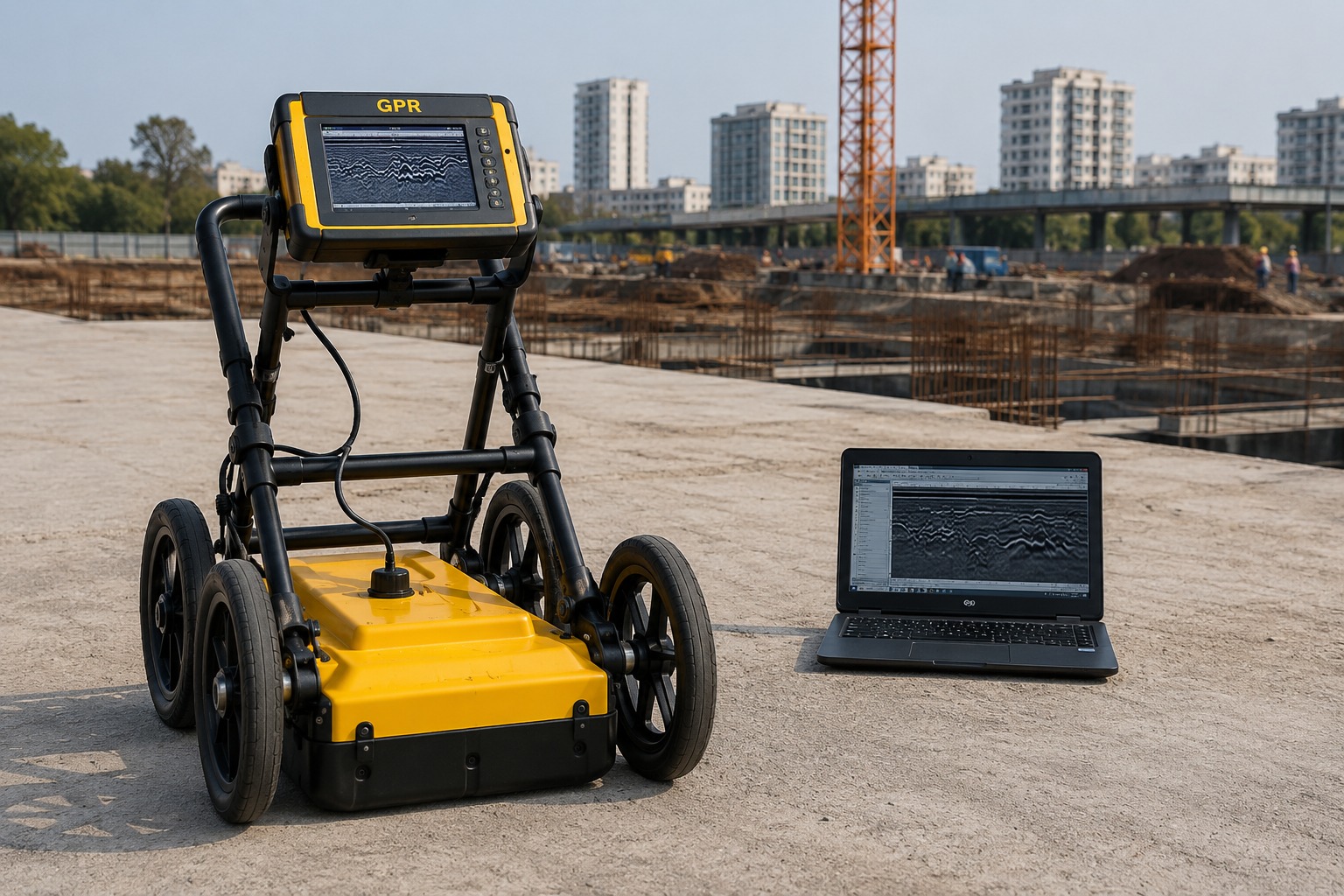
Vijayawada, one of Andhra Pradesh's fastest-growing commercial and infrastructure hubs, is experiencing significant development in highways, bridges, metro infrastructure, residential townships, industrial facilities, commercial complexes, educational institutions, and public utility projects. Every successful construction project begins with detailed site investigation to ensure safe and durable foundations. GPR Survey, Geotechnical Investigation, Piling at Vijayawada, Andhra Pradesh help engineers, architects, builders, and contractors understand underground conditions before construction.
ASurvey is a trusted engineering survey company offering advanced Ground Penetrating Radar (GPR) Survey, Geotechnical Investigation, Soil Testing, Borehole Drilling, and Piling Investigation services across Vijayawada and Andhra Pradesh. Our experienced professionals use modern equipment and scientific testing methods to deliver accurate engineering reports that support efficient planning and reliable foundation design.
Whether your project involves residential buildings, commercial developments, industrial plants, highways, railways, bridges, airports, or government infrastructure, our comprehensive investigation services help reduce risks and improve construction quality.
Ground Penetrating Radar (GPR) is a non-destructive geophysical technique that sends high-frequency electromagnetic pulses into the ground and records the signals reflected back from subsurface materials. Variations in soil density, moisture content, buried objects, and layer boundaries each produce distinct radar signatures, which trained geophysicists interpret to create an accurate picture of subsurface conditions—without excavation.
A standard GPR survey can detect:
GPR is fast, non-invasive, and repeatable over large or congested sites, making it a standard preliminary step before detailed geotechnical investigation and piling design in Vijayawada’s busy urban environment.
Vijayawada lies along the Krishna River, characterized by a mix of riverbank alluvial soils, dense old-city construction, and rapidly growing suburban areas. This combination of variable soil conditions and congested underground infrastructure creates challenges for piling work.
A properly executed GPR survey for geotechnical investigation and piling in Vijayawada, Andhra Pradesh helps address:
Many large construction projects require deep foundations due to varying soil conditions. Piling investigation helps determine the correct pile type, depth, diameter, and load-bearing capacity by evaluating:
Professional piling investigations improve foundation stability and optimize construction costs.
Choosing these services offers:
ASurvey provides investigation services for:
Our engineers employ modern surveying and testing equipment, including:
These technologies ensure highly accurate measurements and dependable engineering reports.
Site Inspection
Engineers inspect the site and assess project requirements.
Survey Planning
Customized investigation plan developed per project specifications.
Field Investigation
Includes GPR survey, borehole drilling, soil sampling, standard penetration testing, underground utility detection, soil logging, and laboratory testing.
Engineering Analysis
Geotechnical experts evaluate all field and lab data.
Final Report
Comprehensive report includes soil profile, lab test results, foundation and pile design recommendations, and construction guidelines.
| Aspect | GPR Survey | Traditional Borehole Exploration |
|---|---|---|
| Invasiveness | Non-destructive, no drilling | Requires drilling and soil extraction |
| Speed | Rapid, covers large areas | Slower, limited to point locations |
| Cost (wide coverage) | Generally lower for large sites | Higher due to multiple boreholes |
| Data Type | Continuous subsurface profile | Discrete point samples |
| Utility Detection | Excellent | Not designed for utility detection |
| Soil Sample Analysis | Not possible | Provides physical soil samples |
| Best Used For | Preliminary mapping, utility avoidance, void detection | Detailed soil classification, bearing capacity testing |
For Vijayawada’s dense urban redevelopment and riverbank expansion, the most effective approach combines GPR for rapid wide-area mapping and targeted boreholes for detailed soil sampling of key zones identified by GPR.
Our services support:
Best Practice: Use GPR as a complementary tool alongside conventional geotechnical exploration, especially in Vijayawada’s older, densely built zones where underground conditions are less predictable.
Vijayawada is rapidly expanding with transportation projects, commercial developments, residential communities, industrial parks, and government infrastructure. As construction activity grows, detailed subsurface investigations become essential to ensure safety and efficiency. GPR Survey, Geotechnical Investigation, and Piling services in Vijayawada, Andhra Pradesh enable project owners to identify underground utilities, assess soil conditions, and design reliable foundations that support long-term structural performance.
As Vijayawada grows as a major commercial and transportation hub alongside the developing Amaravati capital region, building safely on its mix of riverbank alluvial soil and dense urban infrastructure requires more than assumptions. A well-planned GPR survey for geotechnical investigation and piling in Vijayawada, Andhra Pradesh provides engineers, contractors, and developers with the subsurface visibility needed to design safer, more reliable pile foundations while navigating variable soil conditions, high water tables, and congested underground utility networks.
Whether planning a commercial high-rise, flyover or road project, riverbank development, or redevelopment in Vijayawada’s historic core, combining GPR technology with conventional geotechnical investigation is the smartest way to build on solid, well-understood ground in Vijayawada and across Andhra Pradesh.