Amazing Limited Time Offer !
Call : +91 7771811100, +91 7771811104
Accurate Surveying and Construction



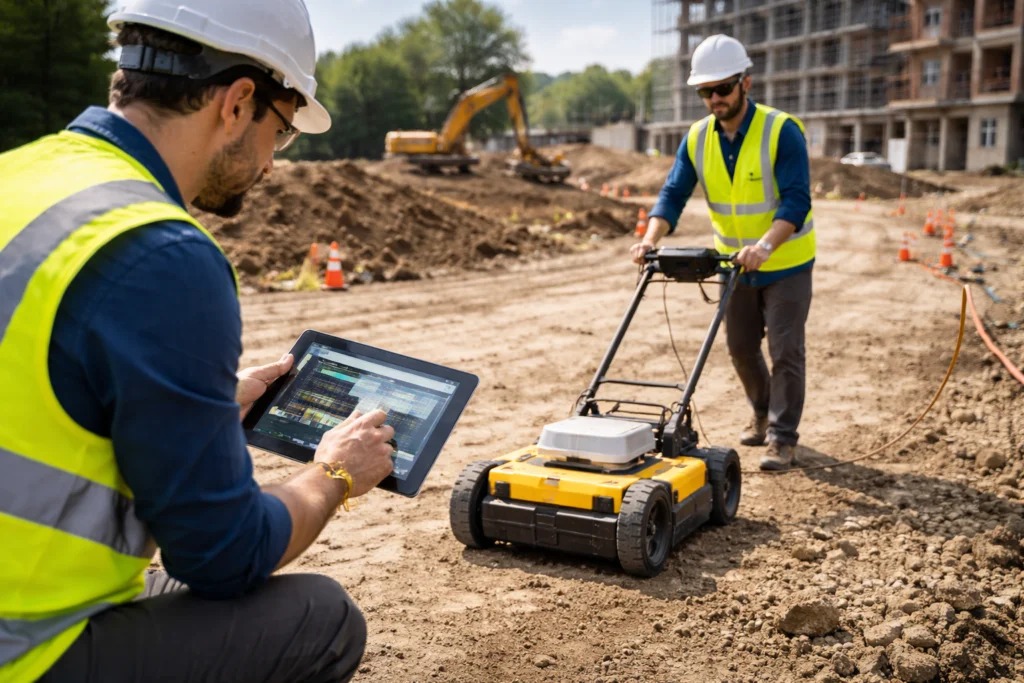
Amaravati, the planned capital region of Andhra Pradesh, is experiencing rapid development with government buildings, commercial complexes, residential townships, highways, educational institutions, industrial parks, and public infrastructure projects. Every successful construction project begins with accurate site assessment before excavation and foundation work.
GPR Survey, Geotechnical Investigation, Piling at Amaravati, Andhra Pradesh provide crucial engineering data that helps developers, consultants, architects, and contractors build safe, durable structures.
ASurvey is a leading provider of Ground Penetrating Radar (GPR) Survey, Geotechnical Investigation, Soil Testing, Borehole Drilling, and Piling Investigation services across Andhra Pradesh. Our experienced engineers employ advanced equipment and proven methodologies to deliver precise reports that support efficient project planning and robust foundation design.
Whether your project involves residential buildings, commercial complexes, bridges, highways, railways, industrial facilities, or government infrastructure, our comprehensive investigation services help minimize risks and maximize construction quality.
Ground Penetrating Radar (GPR) is a non-destructive geophysical technique that transmits high-frequency electromagnetic pulses into the ground and records the reflected signals from subsurface materials. Variations in soil density, moisture, buried objects, and layer boundaries produce distinct radar signatures, which trained geophysicists interpret to create an accurate picture of subsurface conditions—without excavation.
A standard GPR survey can detect:
GPR is fast, non-invasive, and repeatable over large areas, making it essential for preliminary investigation before detailed geotechnical and piling design in Amaravati’s greenfield construction projects.
Amaravati lies on the Krishna River floodplain, formed by centuries of river deposits. This results in:
A well-executed GPR survey addresses these challenges effectively.
a) Utility Detection GPR Survey
Maps underground pipelines, cables, and ducts to protect Amaravati’s infrastructure during piling or excavation.
b) Subsurface Soil Profiling Survey
Identifies soil layering and moisture transitions, crucial for mapping riverine alluvial deposits before foundation design.
c) Bearing Strata and Consolidated Layer Detection
Estimates depth to firmer soil or bearing strata, aiding pile length determination beyond scattered boreholes.
d) Void and Cavity Detection Survey
Locates underground voids, irrigation channels, abandoned wells, and buried debris, important due to Amaravati’s agricultural past.
e) Concrete and Rebar Scanning
Examines existing structures to locate rebar, embedded conduits, and post-tension cables before coring or drilling.
f) Structural Condition Assessment Survey
Assesses existing foundation conditions prior to reinforcing or extending with additional piling, relevant for bridges and roads in the capital region.
Many projects in Amaravati require deep foundations due to varying soil conditions. Piling investigation determines the most suitable pile design by evaluating:
Professional piling investigation reduces structural settlement and enhances foundation safety.
Choosing these services offers:
ASurvey provides investigation services for:
Our engineers use modern technology for precise investigations:
This technology ensures accurate measurements and dependable reports.
Site Inspection
Engineers inspect the site and review construction requirements.
Investigation Planning
Customized investigation plan prepared per project specifications.
Field Investigation
Includes GPR survey, borehole drilling, soil sampling, SPT testing, utility mapping, soil logging, and laboratory testing.
Engineering Evaluation
Geotechnical experts analyze field and lab data.
Final Report
Detailed report covering soil profile, lab results, foundation and pile design recommendations, and construction guidelines.
Best Practice: Use GPR surveys as complementary tools alongside conventional geotechnical exploration, especially considering Amaravati’s variable riverine soil conditions.
Amaravati continues to attract significant investments in government infrastructure, transportation networks, educational institutions, commercial developments, and residential projects. With rising construction activity, precise subsurface investigations are more critical than ever. GPR Survey, Geotechnical Investigation, and Piling services in Amaravati, Andhra Pradesh assist project owners in identifying underground utilities, assessing soil conditions, and designing reliable foundations—ensuring safe, efficient, and cost-effective construction.
Q1: How deep can a GPR survey detect subsurface features in Amaravati?
Depending on soil conditions and antenna frequency, GPR typically detects features from less than a meter to several meters deep. High water tables and clay-rich alluvial soils can reduce effective penetration depth.
Q2: Is GPR survey mandatory before piling in Amaravati?
While not universally mandatory, GPR surveys are strongly recommended due to variable riverine soil conditions and rapidly expanding underground utility networks in the capital region.
Q3: Can GPR replace boreholes entirely?
No. GPR is best used to guide and reduce the number of boreholes but cannot replace them. Physical soil samples remain essential for laboratory classification and bearing capacity testing.
Q4: How long does a typical GPR survey take in Amaravati?
Most piling-zone surveys are completed within one to a few days, depending on site size, followed by data processing and report generation.
A successful construction project begins with accurate engineering investigations. GPR Survey, Geotechnical Investigation, and Piling services in Amaravati, Andhra Pradesh provide essential data for safe excavation, strong foundations, and durable infrastructure.
ASurvey offers comprehensive Ground Penetrating Radar Surveys, Geotechnical Investigations, Soil Testing, Borehole Drilling, and Piling Investigation services, leveraging advanced technology and experienced professionals. From utility detection to foundation recommendations, we deliver dependable engineering solutions for residential, commercial, industrial, and government projects throughout Amaravati and Andhra Pradesh.
Choose ASurvey for precise site investigations, detailed technical reports, timely project execution, and expert engineering support for your next construction project.