Amazing Limited Time Offer !
Call : +91 7771811100, +91 7771811104
Accurate Surveying and Construction



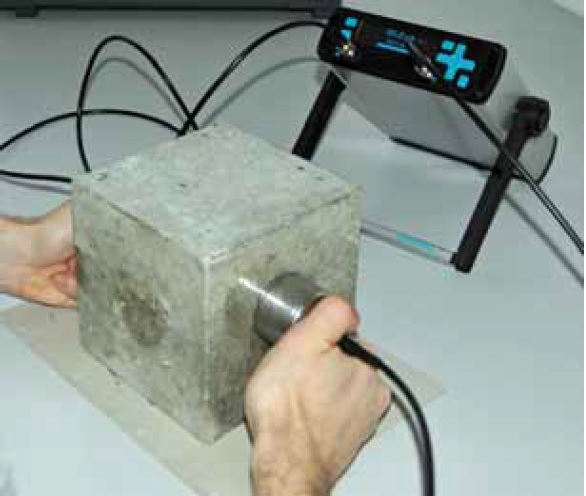
Ultrasonic Pulse Velocity Test Survey Service in Delhi provides a non-destructive method for assessing the quality, uniformity, and internal condition of concrete. The testing supports structural inspection, concrete quality assessment, defect investigation, repair planning, and infrastructure maintenance.
Concrete forms the foundation of many residential, commercial, industrial, institutional, and infrastructure structures. While concrete offers excellent strength and durability, engineers often need to evaluate the condition of hardened concrete without damaging structural members. Since visual inspection alone cannot reveal every internal variation, crack, void, honeycombing, or change in concrete quality, non-destructive testing methods have become essential in modern structural assessment.
A professional Ultrasonic Pulse Velocity (UPV) Test Survey Service in Delhi helps engineers assess concrete quality by measuring the travel time of ultrasonic pulses through concrete members. This test provides valuable information about concrete uniformity, continuity, and potential internal anomalies. Engineers use UPV results alongside visual inspection and other testing techniques to gain a comprehensive understanding of structural condition.
Ultrasonic Pulse Velocity, or UPV, is a non-destructive testing method to evaluate the quality and uniformity of concrete. The test sends an ultrasonic pulse through a concrete element and measures the time it takes for the pulse to reach a receiving transducer.
The measured pulse velocity reveals internal concrete characteristics. Variations in velocity can indicate differences in material condition, but results must be interpreted considering factors like concrete composition, moisture, age, path length, reinforcement, and site conditions.
Thus, UPV testing complements other concrete investigation techniques rather than replacing a full structural evaluation.
Concrete can develop internal imperfections invisible from the surface. Factors such as construction quality, compaction, curing, material proportions, cracking, moisture, and environmental exposure can affect concrete performance.
A professional Ultrasonic Pulse Velocity Test Survey Service in Delhi supports engineers by providing insights into concrete uniformity and potential internal anomalies.
The test aids in:
This methodical, standards-based process is central to every Ultrasonic Pulse Velocity Test Survey Service in Delhi we provide, ensuring dependable and well-documented results.
Our team conducts UPV testing in diverse scenarios such as:
The transducer arrangement depends on structural element accessibility and test objectives:
The choice of method depends on structure, accessibility, objectives, and project requirements.
Several factors influence UPV measurements, including:
Therefore, engineers should interpret UPV results in the context of project-specific conditions and complementary information, rather than relying solely on pulse velocity values.
Real estate developers, structural consultants, government agencies, and heritage conservation bodies across Delhi depend on Ultrasonic Pulse Velocity (UPV) testing for routine structural assessments. Ageing government buildings, high-rise developments in Delhi NCR, and structures undergoing renovation or repurposing often require UPV testing to verify concrete condition before proceeding with further work.
Ultrasonic Pulse Velocity (UPV) testing offers an effective non-destructive method to evaluate concrete uniformity and detect potential internal anomalies. By measuring the travel time of ultrasonic pulses through concrete, professionals acquire essential field data without causing significant structural damage.
A trusted Ultrasonic Pulse Velocity Test Survey Service in Delhi provides critical support for assessing a wide variety of structures, including residential buildings, commercial properties, industrial facilities, bridges, flyovers, institutional buildings, and other infrastructure projects.
When combined with the right equipment, systematic field protocols, skilled technicians, accurate interpretation, and detailed technical reporting, UPV testing becomes a vital component of a comprehensive concrete condition-assessment program, ensuring safety and integrity throughout a structure's lifespan.
Ultrasonic Pulse Velocity Test Survey Service in Delhi provides a non-destructive method for assessing the quality, uniformity, and internal condition of concrete. The testing supports structural inspection, concrete quality assessment, defect investigation, repair planning, and infrastructure maintenance.