Amazing Limited Time Offer !
Call : +91 7771811100, +91 7771811104
Accurate Surveying and Construction



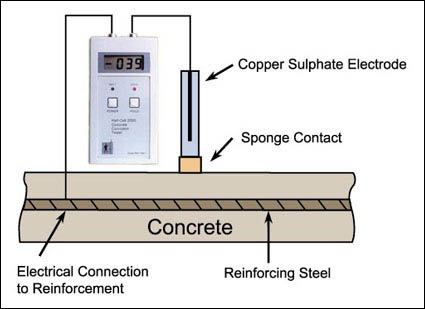
Half-Cell Potential Test Survey Service in Gujarat helps assess the probability of corrosion activity in embedded reinforcing steel within reinforced concrete structures. The non-destructive testing method supports structural condition assessment, maintenance planning, and corrosion monitoring.
Reinforced concrete structures provide essential strength and durability for buildings, bridges, industrial facilities, parking structures, water-retaining structures, and other infrastructure. However, corrosion of embedded steel reinforcement can gradually compromise concrete durability, leading to cracking, delamination, and deterioration. Effective non-destructive testing is therefore crucial to evaluate the condition of existing reinforced concrete.
The Half-Cell Potential Test offers an electrochemical method to estimate the corrosion potential of uncoated steel reinforcement within concrete. Standardized by ASTM C876-22b, this test is widely used for assessing corrosion activity in both field and laboratory concrete.
A professional Half-Cell Potential Test Survey Service in Gujarat assists engineers, contractors, property owners, infrastructure agencies, and facility managers by identifying areas with a higher likelihood of active reinforcement corrosion. This enables targeted follow-up investigations and maintenance planning.
This non-destructive electrochemical test measures the probability of active corrosion in steel reinforcement embedded in concrete. A reference electrode, typically a copper-copper sulfate half-cell, is placed on the concrete surface and connected to a voltmeter, which is also connected to the exposed reinforcement bar.
The electrical potential difference between the reinforcement and reference electrode is measured at multiple points on a grid across the structure. These readings are plotted as a potential contour map, where more negative values generally indicate a higher likelihood of corrosion. This mapping allows engineers to visualize corrosion risk across the entire structure rather than relying on isolated measurements.
Gujarat’s long coastline, industrial zones, and chemical processing areas create some of the most aggressive environments for reinforced concrete durability in India. Chloride-rich air near ports such as Kandla and Mundra, industrial emissions around Vapi and Ankleshwar, and pervasive high humidity accelerate corrosion in exposed concrete structures.
Bridges, jetties, industrial plants, and coastal buildings are especially vulnerable, making regular corrosion assessment vital for asset owners. A locally experienced Half-Cell Potential Test Survey Service in Gujarat understands these environmental risks and interprets results within this context to deliver meaningful, actionable insights.
A systematic procedure ensures consistent and useful measurements:
Preliminary Inspection:
Technicians examine the concrete surface, noting visible cracks, stains, spalling, moisture conditions, and other relevant factors.
Reinforcement Connection:
An electrical connection is established with the embedded reinforcing steel at an accessible location.
Reference Electrode Placement:
A reference electrode, typically a copper/copper sulfate electrode, is placed on the concrete surface.
Potential Measurement:
The potential difference between the embedded reinforcement and the reference electrode is measured at selected points.
Grid-Based Survey:
Measurements are taken over a defined grid to create a corrosion-potential map of the concrete area.
Data Interpretation:
Engineers analyze the potential values and spatial patterns, considering environmental and concrete conditions to assess corrosion probability.
Reporting:
A detailed report is prepared, including project details, test locations, measurements, observations, potential maps, and technical interpretations.
Half-cell testing supports condition assessments for various reinforced concrete structures, including:
Preventive maintenance extends the service life of reinforced concrete by identifying deterioration early, before extensive damage occurs. Periodic Half-Cell Potential Testing, combined with visual inspections and other methods, helps engineers develop effective maintenance strategies tailored to Gujarat’s challenging environmental conditions.
Port authorities, industrial plant owners, highway agencies, and building management companies throughout Gujarat depend on Half-Cell Potential Testing as part of routine structural health assessments. Coastal infrastructure near Kandla, Mundra, and Bhavnagar, along with industrial corridors around Vapi, Ankleshwar, and Vadodara, frequently require this testing to manage corrosion risk in harsh environmental conditions.
Reinforcement corrosion can significantly impact the durability and long-term performance of reinforced concrete structures. Half-Cell Potential Testing offers a practical, non-destructive method to estimate the likelihood of active corrosion in uncoated reinforcing steel.
A reliable Half-Cell Potential Test Survey Service in Gujarat supports structural audits, bridge inspections, industrial maintenance, commercial building evaluations, rehabilitation projects, and infrastructure condition surveys.
By combining precise field measurements, systematic corrosion mapping, expert interpretation, and complementary testing where necessary, engineers gain a comprehensive understanding of reinforcement corrosion. This enables informed decisions on further investigation and maintenance to ensure structural longevity and safety.
Half-Cell Potential Test Survey Service in Gujarat helps assess the probability of corrosion activity in embedded reinforcing steel within reinforced concrete structures. The non-destructive testing method supports structural condition assessment, maintenance planning, and corrosion monitoring.